

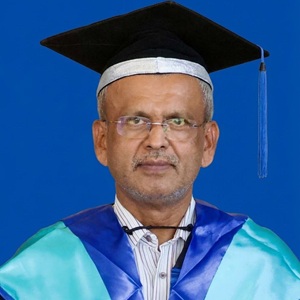
Prof. Padmanathan Kathirgamanathan
Professor in Engineering Mathematics
Head, Department of Interdisciplinary Studies
B.Sc (Hons), Dip in IT, MCMS (Waikato), PhD (Mathematics), PhD(Mechanical Engineering)
Research interests : Finite element modelling of engineering related problems.
.
pkathir@eng.jfn.ac.lk
+94-21-206-0160
Padmanathan Kathirgamanathan is a Professor in Engineering mathematics, with expertise in numerical methods, mathematical modelling, and optimization. He holds dual PhDs in Mathematics and Engineering, reflecting a strong interdisciplinary background that integrates theoretical analysis with practical engineering applications.
Over the course of his academic career, he has developed a consistent record in teaching, research, and academic service. His research focuses on applying computational and mathematical techniques to address real-world engineering and decision-making problems, particularly in areas such as Mechanical Engineering, Environmental Engineering, Transportation Engineering, Geotechnical Engineering, Finance and Economics. He has published in recognized journals and continues to contribute to the advancement of applied mathematical methods.
Padmanathan Kathirgamanathan is actively engaged in undergraduate teaching, curriculum development, and student supervision. He is committed to fostering analytical thinking, problem-solving skills, and research-oriented learning among students. His mentoring has supported the development of young researchers and encouraged academic progression.
In addition to his academic responsibilities, he contributes to institutional and collaborative activities that support the growth of interdisciplinary research. His current focus includes strengthening research culture, expanding collaborations, and integrating research with teaching.
He is committed to advancing Engineering Mathematics as a practical and impactful discipline, contributing to both academic excellence and the development of future engineers and researchers.
Overview: Finite element modelling of engineering related problems.
Client: Ministry of Business, Innovation and Employment, New Zealand
Position Held: Research Scientist/Engineer
Brief: This project discusses the most advance techniques for buried pipes subjected to seismic loads. Effects of soil-structure interaction, pipe embedment, soil layering, material nonlinearity, and ground water table fluctuation are considered. Number of numerical models are developed within a finite element analysis framework in order to evaluate the dynamic stresses acting on buried pipes under the hypothesis that the soil is an elastic-plastic medium and the pipe can be held to be continuous or segmented. A number of real examples from damaged Christchurch area are investigated.
Client: New Zealand Transport Agency, New Zealand
Position Held: Research Scientist/Engineer
Brief: This research seeks to understand the possible advantages that various types of geo synthetic materials (geo cell, geo grid) might offer for the stabilization of pavement base course in situations of high shear, and where geological (aggregate/ground strength) or construction deficiencies exist or arise.
Client: Christchurch city council, New Zealand
Position Held: Research Scientist/Engineer
Brief: This project investigates the behaviour of the rock fall protection embankments under the impact of rock blocks with high kinetic energies.
Client: Foundation for research science and technology, New Zealand
Position Held: Research Scientist/Engineer
Brief: This goal of a project is to develop a 3-D finite element model of a chip seal road surfacing.This research is a response to the challenge posed to the sustainability of the road network by the escalating costs of road maintenance being brought about by growing heavy vehicle numbers and the inefficient use of increasingly expensive, non-renewable resources, i.e. petroleum bitumen and aggregates.
[/toggle]
Client: Foundation for research science and technology, New Zealand, New Zealand
Position Held: Research Scientist/Engineer
Brief: The project improves knowledge of the pavement deformation process and will lead to better pavement designs, increase of pavement life before failure and minimize of maintenance cost of the pavement.
Client: Ulrich Aluminium, Hamilton, New Zealand
Position Held: Researcher
Brief: The goal of this project is to investigate a technique to find an optimal set of conditions tom extrude a product for a given shape and material properties with minimal defects.
Client: Massey University, New Zealand
Position Held: Researcher
Brief: The goal of this project is to build up an inverse model capable of finding release rate and location of atmospheric pollution by using measured pollution concentration data at some locations on the ground.
Client: Landcare Research, New Zealand
Position Held: Matlab Programmer
Client: University of Waikato, New Zealand
Position Held: Researcher